Amadeus developer / publisher · official store artwork · View original source ↗
Amadeus
Real-time multimodal desktop agent evolving toward a persistent AI OS interface (0.17 α).
Real-time multimodal desktop agent evolving toward a persistent AI OS interface (0.17 α).
Visit official source ↗Source reviewed 2026-10-25. Check the developer’s current requirements.Meet Amadeus
Local models: NVIDIA CUDA cu124 · AMD ROCm / Windows (experimental) · Apple MPS Quick start · Website & resources · Installation profiles · Contribute
Amadeus is a real-time multimodal desktop agent that brings voice, character presence, and Agent work into one interface. Speak or type naturally, delegate tasks to specialized Providers, and stay involved through visible progress, permission requests, and controls to resume or take over.
The desktop app and Host run locally, with remote services or local inference selected through model configuration. Character packs are optional: Chat and Work remain available without them.
What you can do
Feature 1
Click the image to watch the full 10-minute demo.
Feature 2
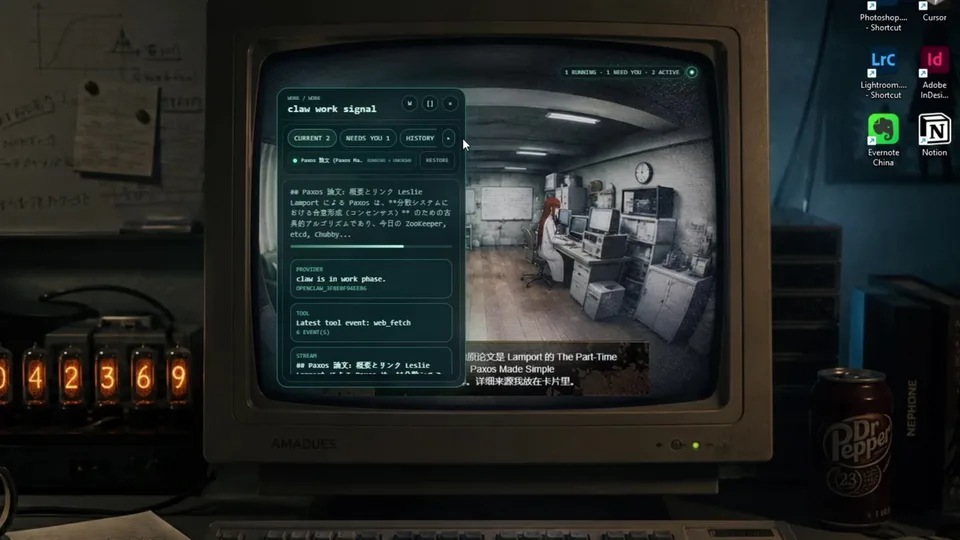
The video demonstrates real-time voice, character performance, desktop scenes, Browser / OpenClaw tasks, and a paper-research flow. The desktop UI, Provider integration, and asset boundaries have continued to evolve, so the video is a product slice rather than a pixel-exact installation preview.
Feature 3
[!NOTE] The header is a brand illustration; the demo screenshots show the prototype. Characters, scenes, voices, and other third-party material in the header or demo are not granted rights by the Amadeus code license. Public source does not include character packs, model weights, reference audio, or authoring intermediates without confirmed redistribution rights.
Feature 4
MCP and Skills remain compatible-Provider capabilities even when they share a Host registry; Main Chat cannot invoke MCP tools directly. Remote DeepSeek is the Main Chat baseline; remote ASR/TTS remain explicit compatibility routes. A local voice failure never silently uploads data or creates a second billable request.
Getting started
Dependencies are grouped into four capability tiers. Start with the minimal T1 installation, then add the tiers you need. A tier is a recommended install preset: each one is a strict superset of the one below it, and the extras themselves encode that (vad includes voice; every local-<build> includes vad). Platforms are not capped; the table below only recommends a tier and build per platform. Terminology is fixed by the tier and build taxonomy.
All profiles use uv and Python 3.12; CI pins uv 0.12.8.
Linux users should start with Linux below.
T3 and T4 need a Torch build, selected independently of the tier: torch-cpu for T3, or one of local-cpu, local-cu124, local-cu128, local-mps, and local-rocm for T4. The default T1 and T2 presets stay Torch-free; optional extras such as rag with torch-cpu may still add Torch. Longer commands that also name voice and vad remain valid and select the same environment. Optional character RAG adds local embedding/Torch dependencies to whichever command you use.
Will it fit your setup?
Desktop Pets details
- Lives on
- Not confirmed
- Click-through
- Not confirmed
- Measured RAM
- Not measured
Before you bring them home
Collected automatically from the linked source. Category, compatibility, technical claims, and media require editorial review.
Unknown specifications are marked as not confirmed. Review the developer’s requirements, privacy terms, and current pricing before choosing your companion.
Suggest a correction →